The layer report · Knitwear & Layers
How a Knit Recovers: Rib, Elastane and Blocking
Why a stretched cuff stays stretched, how rib and elastane differ in recovery, and how to block a wool knit back to its shape without felting it.
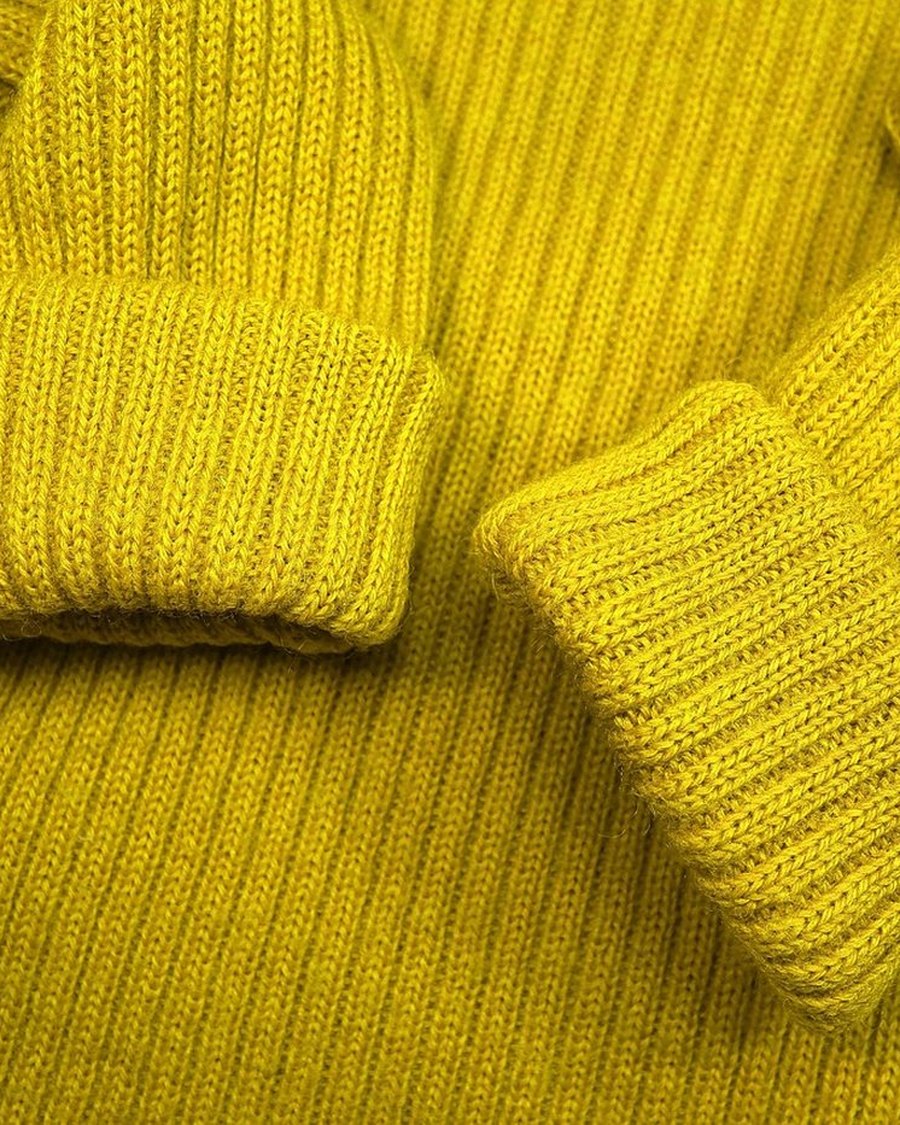
A cuff that has stretched does not usually need replacing. It needs a diagnosis. A rib that has lost its spring, a jersey cuff that never had any, and a cuff whose elastane has died all look the same hanging off the sleeve, and only one of the three responds to water. Work out which structure you are looking at before you fill a basin or price a repair.
Rib is a folded structure, jersey is a stretched loop
A 1x1 rib alternates one knit column with one purl column. At rest the purl columns sit behind the knit columns and the fabric contracts, so its resting width is narrower than the width at which it was knitted. The yarn path through the cloth is longer than the distance it spans. Pull and the columns rotate apart; release and the yarn returns to the shorter arrangement. The reserve is geometry, which is why a cotton rib recovers where cotton jersey of the same yarn does not.
Jersey has no folded columns. Every loop is drawn to one face, so stretching bends the loop legs rather than opening a structure. Recovery then depends on fiber grip: wool jersey returns a fair amount because the fiber has crimp, cotton jersey returns very little, and a cotton jersey neckband on a cheap tee goes wavy within a season.
Two things describe how much a rib has to give. The pattern decides the fold: 2x2 holds more than 1x1, at the cost of a chunkier edge. The depth decides distribution: a 20 to 30 mm rib has enough columns to spread load around the wrist, while a 5 mm binding is usually a folded strip of body cloth rather than a rib. A cuff knitted separately and joined with a seam also carries more rows than one cut from the body panel, and rows are where the reserve lives.
Elastane is credit, not durability
Elastane appears in trims at roughly 2 to 4 percent because it takes load earlier and returns faster than wool does. The filament absorbs the first stretch and hands the rib back its shape. In a new garment this reads as quality. It is closer to a loan.
Three things end the loan. Stress relaxation: hold the filament stretched at skin temperature long enough, as a pushed-up sleeve does over a winter, and it takes a set in the deformed shape. Heat: a tumble dryer, a hot wash or an iron on the cuff degrades the polymer permanently. Chlorine and ultraviolet exposure are slower and cumulative.
There is a construction problem underneath. Because the elastane recovers, a cuff containing it is often knitted with fewer rows than an all-wool cuff needs. While it works nobody notices. When it goes, the rib is exposed as under-built, which is why a cuff can feel fine for two years and then go slack in a month. A relaxed cuff with a glazed fold line and no snap is usually this case, and water will not bring it back.
Wool’s spring, and the point where it fails
Wool has a natural crimp, and Woolmark describes the fiber as elastic and able to recover from stretching. That is why a wool rib outlasts a cotton one, and why wool answers to water and reshaping.
The limit is felting. Wool fibers carry scales, and when the cloth is wet, warm and agitated those scales lock, and the fabric tightens and thickens permanently. This is not shrinkage back to a smaller size. The material has changed, and recovery is gone rather than slow.
The two states separate in the hand. A relaxed knit is limp but open: stitches distinct, surface flat, fabric pushable back to width. A felted knit is dense and matted, stitch definition closed, surface faintly board-like. Only the first is worth working on.
The wash does more damage than the wear
Wet wool is heavy. On a hanger, that weight pulls length into the body and pushes humps into the shoulders, and the distortion sets as it dries. Woolmark’s guidance is flat drying in the shade, reshaped by hand while damp, and it decides whether a knit returns to its measurements or gains length season after season.
Wringing does the same faster, because it stretches the cloth while the fibers are swollen. Press the water out against the side of a basin or roll the garment in a towel. Keep it off radiators and out of direct sun, both of which dry the face before the core.
Frequency matters as much as method. A sweater worn over a shirt needs airing between wears and a wash every eight to ten wears, not every two. Each wash is a small felting risk, so brushing and airing do more for a sweater than washing does.
Blocking a stretched cuff back
Measure the target, not the damaged cuff. Use the other cuff if it still holds, or your wrist circumference plus about a centimeter of ease, and write the number down.
Wet only the cuff, at 30 to 40 degrees Celsius, then massage the rib between finger and thumb. Woolmark suggests this local treatment for a distorted area, and confining the water to the cuff leaves the body of the sweater undisturbed.
Press the water out in a towel rather than wringing. Lay the sleeve flat and push the rib back to the recorded width, working from the seam outward so the columns distribute evenly. Do not pull the sleeve length at the same time; the cuff will steal it back as it dries.
Dry flat, away from heat, for twelve to twenty-four hours. Check it while still damp and reset it once, because a rib that has crept will stay crept. If the width drops again within a week of wear, the elastane is gone and the cuff needs replacing rather than reshaping.
Three cases do not respond. A felted cuff cannot be reopened. A cuff with dead elastane holds shape until the first wear. A binding that was never a rib has no reserve to restore. For a sound sweater in the last two cases, a repair service can attach a new cuff for a fraction of replacement cost; the alternative is to shorten the sleeve, which removes the problem and changes the garment.
What to check at the rail
Look for a band at least 20 mm deep, a visible 2x2 or 1x1 structure rather than a flat strip, and a seam where the cuff meets the sleeve, which usually means a separately knitted piece with rows to spare. On the label, wool above 50 percent or a small elastane percentage is a reasonable sign; a 100 percent cotton rib will relax with wear.
A finer rib has more columns around the wrist, so each one moves less, the same argument that makes a tight knit wear better at the elbow; gauge from 3 to 14 sets out the scale. A heavy sleeve on a shallow cuff will pull out of shape whatever the rib is.
Keep, repair or retire
Decide from the structure, not the price. If the stitches are open and the fabric is merely limp, block it. If the fabric is matted, stop. If it blocks and drops back within a week, price a cuff replacement against a new sweater, and take the repair only when the body is still sound.
Two things age a knit faster than wear: pilling at the underarm, and a body gone thin enough to show light through it. A cuff is a repairable part; a worn-out body is not, which is why the sweaters worth repairing have dense, even stitches and a hem that still has a fold.
Frequently asked
- Can a stretched wool cuff be shrunk back?
- Often, partly. Woolmark advises dipping the area in water at 30 to 40 degrees Celsius and massaging it by hand, then drying flat. The exception is a garment that was felted in a machine wash, where the fibers have locked together and the shape cannot be recovered.
- Does elastane make a knit last longer?
- It makes the knit hold its shape for a while, then it fails and takes the recovery with it. Two to four percent elastane is common in ribbed trims. Once the elastane has taken a set or been degraded by heat, the rib relaxes and stays relaxed.
- Should knitwear be hung or folded?
- Folded. Woolmark notes that hanging a damp knit stretches it under the weight of the water, and that a hanger distorts the shoulders even when dry. Store sweaters flat, and dry them flat on a towel out of direct sun.