The denim ledger · Denim & Trousers
Wide Legs Work on a Ratio, Not a Size
Divide flat leg opening by front rise and the look becomes predictable. The ratio, the top length that matches it, and the shoe volume underneath.
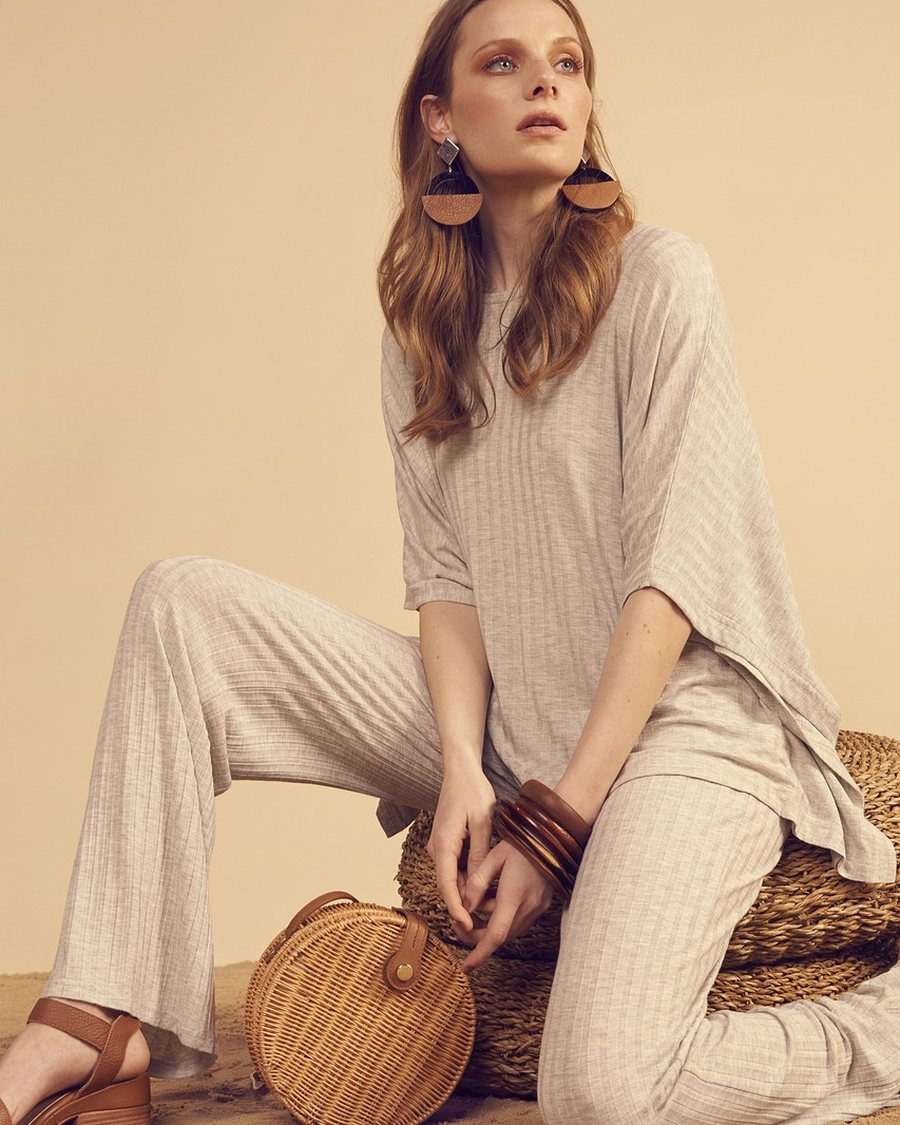
Two trousers can carry the same 10-inch leg opening and read as different garments on the same person, because the eye does not measure width in isolation. It measures the hem against the rise above it, then against the top that ends over it. The number on the label is the least useful figure in that comparison.
The ratio between hem and rise
Divide the flat leg opening by the front rise and the result describes how much width the trouser releases against the height at which it begins releasing it. An 8.4-inch opening over a 10.5-inch rise gives 0.80. A 9.9-inch opening over an 11-inch rise gives 0.90. A 12-inch opening over an 11.5-inch rise gives 1.04.
| Flat opening | Front rise | Opening divided by rise | What it reads as |
|---|---|---|---|
| 8.4 in | 10.5 in | 0.80 | straight leg with room |
| 9.9 in | 11 in | 0.90 | wide, vertical line intact |
| 11.5 in | 11.5 in | 1.00 | full wide leg |
| 12.5 in | 10 in | 1.25 | the hem takes over |
Below 0.85 the trouser is a straight leg, whatever the product page calls it. Between 0.9 and 1.0 it is wide and still holds a vertical line from waist to hem. Above 1.0 the hem becomes the widest part of the silhouette.
The mechanism is distance. A rise sets where the leg line leaves the body and the hem sets where it stops. An 11-inch opening on a 9-inch rise spends the same width over a shorter run of leg, so the flare opens abruptly. The same opening on an 11.5-inch rise releases later and hangs closer to the hip.
How the two numbers are taken
Leg opening is measured flat, seam to seam, across the hem of one leg. Most charts publish that half-measure, so a 10-inch figure describes a 20-inch circumference. Some publish the doubled figure instead, and a chart listing 20 for a wide leg has already done the doubling. The tell is plausibility: no trouser hem is 20 inches across one leg, so that figure has to be a circumference. When the convention is unclear, divide the number by the rise and check that the result lands between 0.7 and 1.3.
Front rise runs from the crotch seam to the top of the waistband, fly closed, on a flat surface. A waistband is usually 1 1/4 to 1 1/2 inches deep, so a chart measuring to the seam where the band joins the trouser rather than to the top edge describes a garment sitting more than an inch lower. Rise, explained in numbers sets out the other conventions that move the figure by half an inch.
Stretch moves both numbers. A 2 percent elastane trouser pulled flat can gain half an inch at the hem and lose a quarter inch at the rise, shifting the ratio by about 0.05.
Where the top should end
The widest point of a wide-leg outfit sits at the hip and upper thigh, which is also where most tops end. There are two safe finishes: a top of 21 to 23 inches measured from the high point of the shoulder, ending above the waistband, or one of 27 to 30 inches worn tucked. The band between 24 and 26 inches, worn out, is where the proportion fails, because the hem lands on the widest part of the trouser and squares off the body.
Those figures assume an average torso. On a short torso a 27-inch shirt already covers the hip; on a long torso a 23-inch top may end at the waistband. Measure a top you own that works with the trouser, shoulder to hem, and compare that number. A tucked or cropped top restores the line without touching the trouser.
The shoe has to fill the hem
A hem that hangs free needs something underneath it. The working figure from wide-leg trousers as one decision is a sole at least a tenth of the flat opening: 0.8 inches under an 8-inch hem, 1 inch under a 10-inch hem, 1.2 inches under a 12-inch hem. Below that the hem looks unmoored; at twice that the shoe looks heavy and the visible leg shortens.
Measure the sole at the forefoot, which is the part under the front of the hem. A 2-inch block heel with a 6 mm forefoot sole puts less under a 10-inch hem than a flat with a 25 mm lug sole, even though the heeled shoe is taller. This is why a wide leg tolerates a platform sneaker and resists a ballet flat.
Open shoes fail differently. A wide hem over a sandal reveals the foot rather than resting on it, and the ankle divides into two horizontal bands. If the shoe is open, the hem needs an inch of clearance above the ankle bone, which turns the trouser into a crop.
Fabric decides whether the ratio survives
A size chart describes cloth at rest. A 10-inch opening in a fluid viscose collapses against the leg by mid-morning and reads as a straight leg, because the fiber has no memory to hold the shape it was cut to. A 10-ounce cotton, roughly 340 GSM, or a 250 to 350 GSM wool twill keeps the line.
Elastane above 2 percent works against a wide leg, because the cloth recovers toward the body instead of hanging away from it. The same percentage in a wool trouser is useful at the seat and knee, where a wide leg loses shape first, and harmful at the hem, where recovery pulls the opening narrow. A lining adds body, which is why two trousers in the same fiber behave differently.
Where the ratio stops working
The ratio normalizes width to rise, so it says nothing about how much leg sits between the two. On a 5-foot-2 frame an 11.5-inch rise can reach the lower ribs, and a 1.04 ratio then puts the widest point near the knee rather than the hip. The fix is a lower rise, 10 to 10.5 inches, and a top that ends above the band.
On a tall frame the same ratio reads narrower, because the flare has more inches of leg to develop over. A 0.9 that looks wide on a 5-foot-4 body can read as a generous straight six inches taller, and the correction is to move toward 1.0 rather than adding width at the hem alone.
Hip width is the third limit. A ratio of 1.0 or above on a body with wide hips puts two widest points close together, the hip and the hem, with nothing between them. In that case a straight leg at 0.8 with a high rise gives a cleaner line.
Alterations only go one way
A wide leg can be narrowed at the hem; a straight leg cannot be widened, because there is no cloth in the seam allowance to give. Most trousers carry a 5/8-inch allowance on each leg seam, and using half of it on each side takes about an inch off the flat hem. Beyond that the tailor is rebuilding the seam.
If the choice is between two sizes of one style, buy the wider one and have the hem taken in. Hem the trouser to the shoe before judging the ratio, since a hem that stacks adds width at the ankle that the chart never mentions; how inseam meets the shoe covers that measurement. A return costs the full price plus shipping; a hem taper costs the alteration and keeps the pair.
Frequently asked
- What is a good rise for wide-leg trousers?
- Ten to 11.5 inches of front rise for most adults, which starts the fullness at the hip rather than mid-thigh. Below 10 inches the same hem reads wider because the cloth releases lower.
- How long should a top be with wide-leg trousers?
- Either 21 to 23 inches so it ends above the waistband, or 27 to 30 inches and tucked. A hem between 24 and 26 inches, worn out, lands at the widest point.
- Do wide-leg trousers need heels?
- No, but they need sole volume. A flat with a thin sole leaves the hem unmoored, while a loafer with an inch of sole, a boot or a platform sneaker gives it something to land on.