The formula · Outfit Formulas
Tuck or Untuck Is a Measurement Question
Body length and front rise decide whether a shirt stays tucked. The numbers behind the tuck, the half-tuck, and the cases where the shirt is simply too long.

A tuck fails in the same place every time: the small of the back, an hour after lunch. The shirt has not shrunk and the trouser has not stretched. Too much cloth has been folded into too narrow a band, and the waistband is sitting somewhere other than where the shirt was cut to finish.
The waistband is the fixed line
Front rise is measured from the crotch seam to the top of the waistband. Published figures for women’s trousers usually run 9 to 12 inches, and the rise that reads formal sits near the top of that band for a structural reason: a higher waistband crosses the body above the hip bone, at the narrowest part of the torso, where there is less flesh to push it down when you sit.
A higher rise also shortens the distance the shirt travels before it disappears, because the band starts higher up the torso. A mid-rise band sits on the hip, and when you sit the seat pushes it up while the shirt, gripped by the band, is pulled down. The shirt loses that argument slowly, over an hour, and then all at once.
Published rise numbers are not taken the same way twice. Some brands measure from the crotch seam, some from where the inseam meets the fly, and that seam sits lower on a lower rise. Two trousers labeled 10 inches can sit nearly an inch apart on the same body. The figure to compare is the one you take yourself: button the trouser, lay it flat, and measure from the top of the waistband to the crotch seam.
Body length, measured at the front hem
Body length runs from the high point of the shoulder to the hem, and size charts for a medium usually land between 26 and 29 inches. Many charts take that measurement at the back, and on a shirt with a curved shirttail the back hem is an inch or two longer than the front. A shirt listed at 29 inches may present 27 inches at the front placket, which is the part that has to stay inside the waistband.
Cotton also moves. A shirt washed and tumble dried can lose length to shrinkage over its first few cycles, and the loss is permanent. A shirt that tucked on the first wear and stopped by the fifth is usually the same shirt, shorter.
The hem finish matters as much as the number. A straight hem gives the same length all round and folds into a waistband cleanly. A curved hem has less cloth at the sides, so a full tuck pulls the side seams forward and the shirt rides up at the hip.
Worn out, the hem has a different target: the hip bone or a little below, roughly 3 to 4 inches under the waistband of a mid-rise trouser. A hem that finishes at the widest point of the hip adds width exactly where the eye is checking, and a hem 6 inches below the band covers the seat and turns the shirt into a short dress.
The arithmetic of what hangs below the band
Shirt length alone does not predict a tuck; the distance from shoulder to waistband does. Measure that on your own body with the trouser on: from the high point of the shoulder, down the front, to the top of the waistband. Subtract it from the shirt’s front body length. The remainder is the cloth that has to go inside the band before it looks tucked.
Under about 6 inches, a full tuck is straightforward. Between 6 and 8 inches, expect a visible fold and a band that needs a belt; this is the zone where a half-tuck earns its place. Above 8 inches, the shirt is long enough that no waistband will hold it all day, and the options are a higher rise, a hem, or leaving it out. These are working ranges: band width, shirt circumference and how long you sit move them.
Circumference matters as much as length. A shirt hem 4 inches wider than the waistband has to lose that cloth somewhere, and it goes into pleats at the back and sides. The more that has to be pleated, the harder the band is pushed away from the body, and the sooner it loosens.
Belts, loops and the grip of the band
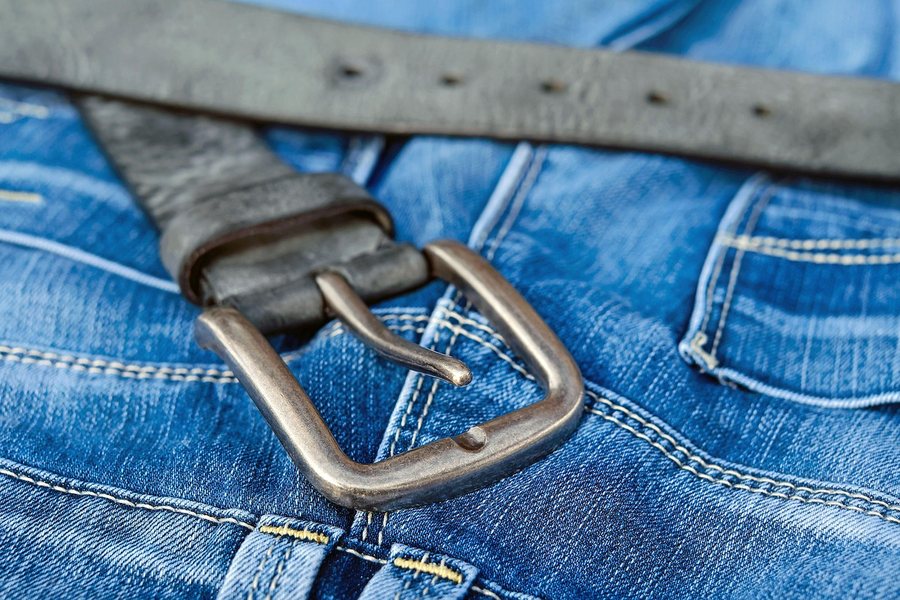
A belt is often asked to fix a tuck it cannot. A strap that fills the loop completely leaves no clearance for shirt fabric, so the cloth bunches at the hip and the belt sits proud of the waistband. A strap about an eighth of an inch narrower than the loop leaves room for the shirt to lie flat underneath.
The waistband itself decides more. A 1.5-inch band with interfacing holds its shape and grips the shirt; a narrow, soft band rolls and lets the cloth slide. A small share of elastane helps the band recover after sitting, but it also lets the band stretch over the shirt; a band that has stretched will not grip the same shirt next month.
The half-tuck and where it fails
The half-tuck puts the front third of the hem inside the band and leaves the rest hanging. It works on a woven shirt with a straight hem, enough body to hold the fold, and a rise that already sits close to the natural waist. It fails on a curved hem, where the sides pull out within the hour; on a knit, where the stretch travels and drags the loose hem down; and on a pleated front, where the tuck adds volume over the fly.
It also changes the line. A half-tuck puts a horizontal fold across the front of the hip and shortens the visible leg by roughly the depth of that fold. On a short torso that is a real cost, as the short-torso formula sets out, and a full tuck or none usually reads cleaner.
What to change, and what it costs
Alter the shirt before the trouser. A hem taken up 2 inches is the least expensive alteration in the wardrobe and it fixes the proportion at every rise you own. The limit is the turn-up: most shirt hems carry half an inch or less, so a shirt can be shortened but never usefully lengthened. Taking 3 inches off a 29-inch shirt leaves a 26-inch shirt with a hem that no longer matches the original curve.
The trouser has no equivalent fix. Rise cannot be meaningfully altered, because the crotch seam, the fly and the pockets would all have to move. A trouser with the wrong rise is a return, not an alteration. That is the expensive mistake: a pair bought for the leg line, worn twice, and abandoned because the band sits an inch and a half below where the shirt needs it.
A decision rule for the morning
If the shirt is under 6 inches longer than your shoulder-to-waistband measurement, tuck it and wear a belt that leaves clearance in the loop. If it is 6 to 8 inches longer, half-tuck it or choose the higher-rise trouser. If it is more than 8 inches longer, wear it out over a trouser with a clean waistband, or have the hem taken up. If the shirt has a curved hem and the top has any stretch, leave it out: that is not a tuck problem, and no belt will settle it.
Frequently asked
- What shirt length should be tucked?
- A shirt under 29 inches can be tucked into a rise of 10 inches or more and will stay. Longer shirts need a higher rise, because there is more cloth to compress into the waistband and more reason for it to work loose when you move.
- Does a half-tuck work on a knit?
- Rarely. A knit stretches, so the tucked section drags the rest of the hem down and the fold distorts within an hour. A half-tuck belongs on a woven shirt with a straight hem and enough body to hold the fold.
- Should I alter the shirt or the trouser?
- Alter the shirt. Taking 2 inches off a hem costs far less than replacing a trouser, and it fixes the proportion at every rise you own. Change the trouser only if the waistband itself will not hold a tuck.