The office · Workwear
Three Blazers Compared by Construction and Vent
Three blazers compared on vent, length, lining and wool content, using only the numbers each brand publishes, plus the two US prices on the page.
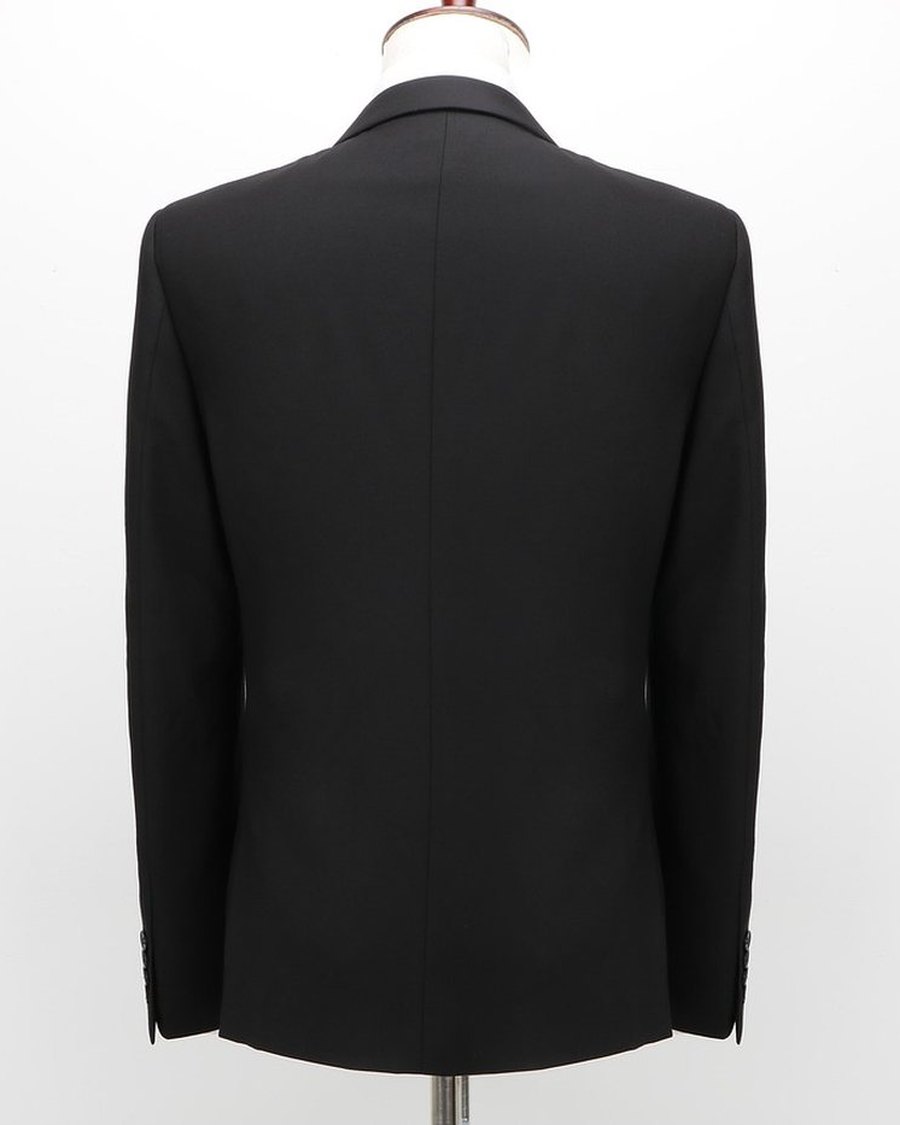
A 23-inch blazer and a 29-inch blazer can share a lapel shape, a single-breasted front and a shoulder that fits. What separates them is the hem: above the waistband, on it, or over the seat. The spread across these three jackets is six inches, and that distance, not the price, decides which trousers each one can be worn with.
Three lengths, three different jobs
The Vince page publishes 29 inches from shoulder to hem. The two J.Crew pages publish 27 1/2 and 23 inches, both from high point of shoulder. Those figures are not perfectly comparable. High point of shoulder sits at the base of the neck; a center-back measurement starts lower down the collar, so part of the difference between the Vince number and the J.Crew numbers may be method rather than cloth. Read the order first, then read the hem on a hanger.
| Hem | What it covers | Trouser rise that works |
|---|---|---|
| 23 in | Ends above the waistband | 11 in or higher, or the jacket worn open |
| 27 1/2 in | Waistband and top of seat | 10 to 12 in |
| 29 in | Seat and upper thigh | Any rise; reads as outerwear |
A jacket that ends above the waistband leaves shirt visible on both sides of the button. One that ends at the waistband covers the belt and makes the jacket the top half of a suit. One that ends at the seat pushes the trouser down the outfit, which is the whole purpose of a longer jacket.
A vent changes the hem, not the fit
A back vent is a slit at the center back seam, running from the hem up to roughly hip level, with a facing of lining cloth behind it. It does not touch the shoulder, the chest or the waist. It changes what the skirt of the jacket does when the two halves of the body move independently: when you sit, climb stairs, or put a hand in a pocket.
Without a vent the hem is a closed tube. Sit down and the back panel has nowhere to go, so it folds across the seat and the hem lifts at the sides. With a vent, the two panels separate and the hem stays closer to level. That is the difference between a jacket that looks tidy from behind after a commute and one that only looks right while you are standing.
Only the Vince page lists a vent, alongside a full lining, an interior chest pocket, flap welt side pockets and three-button cuffs. The two J.Crew pages list lapel, closure and pockets, then stop. A missing line is not proof of absence, but it is a signal: a vent costs an extra panel, a facing and a finished slit, and at $248 to $298 it is one of the first construction details to go. If you sit for most of the day and the jacket stays on, this is the detail to confirm before ordering rather than the lapel shape.
The hem against the rise
Length and rise are one proportion, read together. A 23-inch jacket over an 11-inch rise clears the waistband by an inch or so, which is what the page means by hitting above the waist; the gap at the side shows a narrow band of shirt. The same jacket over a 9-inch rise ends closer to three inches above the band, and the exposed shirt becomes the widest horizontal in the outfit: a deliberate cropped proportion if you chose it, a cold gap if you did not. The range of rises and where each one lands is worth settling before the jacket is chosen, because the jacket is the harder piece to alter.
At 27 1/2 inches the hem covers the waistband and the top of the seat. The belt disappears and the jacket becomes the top half of a suit. At 29 inches the hem covers the seat and the top of the thigh, which is why it reads as outerwear: the trouser starts lower in the eye, and the outfit has three horizontal breaks instead of two.
The order matters more than the exact number. A jacket whose hem lands within an inch of the waistband can be worn with almost any trouser. One that clears the waistband by two inches needs a high rise underneath it, or a shirt short enough that the exposed band reads as a layer rather than an accident.
Wool content does not track price
The three compositions point in three directions. Vince: 65 percent rayon, 35 percent wool, fabric imported from Italy. J.Crew Margeaux: 61 percent recycled polyester, 28 percent viscose, 6 percent elastane, 5 percent polyester, no wool at all. J.Crew High-button: 53 percent wool, 42 percent polyester, 5 percent elastane.
Rayon and viscose are cellulosic fibers. They drape well and recover poorly, which is why a jacket with a high rayon share looks sharp on a hanger and soft at the elbow by the end of a day. Polyester resets with heat and resists abrasion, but it can shine where it is pressed, usually at the seat and the elbows. Wool resets with steam, breathes, and holds a crease. Elastane returns shape but does not make a cloth cooler.
The only wool-majority jacket here is the $298 one. The $248 jacket has no wool and 6 percent elastane. The Vince jacket, whose US price is not published on the page we read, is 35 percent wool. Price order and wool order do not match, and neither tells you whether the fronts are canvassed. None of the three pages uses the words canvas, half-canvas or fused.
The shoulder is the one number nobody prints
None of the three pages gives a shoulder width in inches, a padding note or a canvassing note. Fit words stand in for measurements: classic for the Margeaux, slim for the High-button, and no fit word at all for the Vince.
The measurement can be taken at home. Lay a jacket that fits you flat, measure across the back from one shoulder seam to the other, then compare that with your own shoulder width, bone end to bone end. A jacket needs roughly half an inch to an inch more than the body across the back, depending on whether a knit goes underneath. Below that, the seam sits inside the bone and the sleeve head collapses; above it, the seam hangs past the arm and the jacket looks borrowed.
Slim and classic are not measurements either. A slim 23-inch jacket and a classic 27 1/2-inch jacket can publish the same shoulder width and still feel different, because the armhole depth and the amount of ease through the chest do the rest. Shoulder seam placement is the one alteration a tailor will refuse more often than not, which makes it the number to check before the sleeve.
Sleeves and the alteration bill
Sleeve length is the second thing a tailor changes and the first thing a product page omits. The test is the wrist bone with the arm bent, not straight. A sleeve that ends at the wrist with the arm down will ride up the moment you reach for a keyboard, and most jackets are photographed with the arm down.
Shortening at the cuff is straightforward when the cuff is plain: open the lining, cut, reattach, press. If the cuff has working buttonholes, every buttonhole has to move, and many tailors will decline the job rather than rebuild a functioning cuff. Shortening at the shoulder is a different order of work: the sleeve comes out, the armhole is recut, the sleeve head is reset, and the shoulder line changes. It costs several times what a cuff alteration costs and it can flatten the very line you bought the jacket for. What an alteration is worth paying for depends on which of those two operations the jacket needs.
A jacket bought long in the sleeve is a small problem. A jacket bought narrow in the shoulder is not a problem money solves.
The bodies these three do not fit
The 23-inch jacket is the one that fails most visibly on the wrong frame. On a short torso it ends at the high hip rather than above the waist, so it stops reading as a cropped jacket and starts reading as a jacket that is simply too small. On a long torso it lands correctly, but only over a rise of 10.5 inches or more; over a low rise the exposed shirt band is wide enough to break the line in two.
The 27 1/2-inch jacket covers the waistband on most frames, which makes it the safest of the three for a long torso. On a short torso it can cover the whole torso down to the hip, and the proportion that was meant to be waist-defining becomes a rectangle. The 29-inch jacket on a short frame reaches mid-thigh and reads as a coat; that is not a fault, but it is a different garment from the one the page is selling.
A peak lapel widens the chest, and the Vince jacket combines one with a 65 percent rayon cloth that drapes rather than holds. On a large bust that combination adds width exactly where the jacket already has some. The High-button jacket closes to the neck, which flatters a narrow shoulder and constrains anyone who needs room at the chest. None of the three publishes a sleeve length, so a long arm is a gamble on all of them. The unstructured jacket argument starts from the shoulder for the same reason: it is the one part of the jacket that cannot be adjusted after the fact.
What to wear instead
If the jacket has to close over a sweater, none of these three is cut for it. Size up and take in the waist, or choose a knit coat, which has the ease built in and no button stance to fight.
If you sit for most of the day, a vent matters more than the lapel. If you travel, a wool-rich cloth needs steam to recover; a polyester-rich one needs nothing but shows pressure marks.
If you are buying the outfit from scratch, buy the trouser first. Rise and leg opening are fixed by the cut, while the jacket can be shortened at the hem within limits. A tailor can take two inches off a jacket hem without moving the pockets if the pockets are patch or flap and sit high enough; beyond that, the balance of the front changes and the jacket starts to look shortened rather than short.
Which of the three
If your trousers sit at an 11-inch rise or higher and the jacket stays open, the High-button blazer in lightspun wool blend is the shortest at 23 inches, the only wool-majority cloth of the three, and $298. It is also the least forgiving of a long torso.
If you want a jacket that closes over a shirt and covers the waistband, the Margeaux blazer in four-season stretch at $248 is the middle length, with stretch through the cloth and no wool in it. It is the safest choice for a long torso, and the cloth with the most stretch here.
If you sit for a living and want a hem that opens, the Structured Peak-Lapel Blazer is the only one with a listed back vent and the longest body at 29 inches. It is outerwear more than suit jacket, and its US price is not published on the page we read. Buy it for the vent and the length, not for the 35 percent wool.
The shortlist
What we would pick
Some links below are affiliate links — we may earn a commission at no extra cost to you.
The three blazers sit within $50 of each other and disagree on everything that shows below the waist. Only the Vince jacket lists a back vent, only the J.Crew high-button jacket carries a wool majority, and none of the three publishes a shoulder width, a sleeve length or a canvassing note. Length, not price, is the number that decides which trouser each one works over, and the 23-inch jacket is the one that fails most visibly on the wrong torso.
- Shortlist
- 3 blazers, $248-$298 where priced
- Body length
- 23 in to 29 in
- Wool content
- 0% to 53%
- Vents listed
- 1 of 3
- Shoulder width
- Not published by any of the three
Structured Peak-Lapel Blazer
Vince
The only one of the three with a listed back vent, and the longest at 29 inches. It is lined, with an interior chest pocket, a welt chest pocket, flap welt side pockets and three-button cuffs, in a 65 percent rayon and 35 percent wool cloth with fabric imported from Italy. Peak lapels and a full lining make it read as outerwear rather than as the top half of a suit, which is also why it is the hardest of the three to wear over a high-rise trouser without covering the waistband entirely. It does not suit a short torso: the hem reaches mid-thigh and the jacket stops reading as a jacket. No shoulder width, sleeve length or canvassing detail is published, and no US price appeared on the page.
- Fabric
- 65% rayon, 35% wool; fabric imported from Italy
- Length
- 29 in, shoulder to hem
- Vent
- Back vent
- Lining
- Lined
- Cuffs
- Three-button
- Price
- Not published on page
Margeaux blazer in four-season stretch
USD 248J.Crew
A waist-length single-breasted jacket at 27 1/2 inches from high point of shoulder, which puts the hem over the waistband rather than above it. The cloth is 61 percent recycled polyester, 28 percent viscose, 6 percent elastane and 5 percent polyester, so there is no wool in it; the stretch is what the page sells and the drape is what the viscose does. Notch lapel, welt pockets, classic fit, and no vent or lining note anywhere in the copy. The elastane share helps the jacket recover at the elbow; the trade is that the cloth can mark where it is pressed. It is the middle length and the middle price, and the safest of the three for a long torso.
- Fabric
- 61% recycled polyester, 28% viscose, 6% elastane, 5% polyester
- Length
- 27 1/2 in from high point of shoulder
- Vent
- Not listed
- Fit
- Classic
- Lapel
- Notch
- Care
- Not listed on page
High-button blazer in lightspun wool blend
USD 298J.Crew
The shortest of the three at 23 inches from high point of shoulder, described as hitting above the waist, with a button front that fastens all the way to the neck. It is also the only wool-majority cloth here, at 53 percent wool, 42 percent polyester and 5 percent elastane, and the only one with a stated care instruction: dry clean. Slim fit, notch lapel, welt pockets with flaps. It needs a trouser with a rise of 11 inches or more underneath it, or the gap at the side shows shirt; over a low rise the exposed band is wide enough to break the outfit in two. The neck-high closure flatters a narrow shoulder and constrains anyone who needs room across the chest.
- Fabric
- 53% wool, 42% polyester, 5% elastane
- Length
- 23 in from high point of shoulder
- Vent
- Not listed
- Fit
- Slim
- Lapel
- Notch
- Care
- Dry clean
| Specification | Structured Peak-Lapel | Margeaux | High-button |
|---|---|---|---|
| Length | 29 in | 27 1/2 in | 23 in |
| Vent | Back vent | Not listed | Not listed |
| Wool content | 35% | 0% | 53% |
| Lining | Lined | Not listed | Not listed |
| Lapel | Peak | Notch | Notch |
| Cuffs | 3-button | Not listed | Not listed |
| Price | Not published | USD 248 | USD 298 |
Where these numbers come from
Frequently asked
- Does a back vent make a blazer fit better?
- A vent changes what the hem does when you move, not how the jacket fits at the shoulder. It lets the skirt of the jacket separate at the center seam, which matters most when you sit or put your hands in your pockets.
- Is a higher wool percentage worth paying for?
- Not on its own. Wool content tells you what the cloth is made of, not how it was woven or fused. A 53 percent wool jacket and a 35 percent wool jacket can hang very differently depending on lining and interlining.
- What length blazer works with high-rise trousers?
- A jacket that ends at or just below the waistband, roughly 23 to 25 inches from the shoulder, keeps the rise visible. Anything longer covers the waistband and turns the trouser into the background.