The office · Workwear
Three Wool-Blend Work Trousers Compared by Rise and Hem
Three wool-blend work trousers compared on rise, leg opening, wool content and hem allowance, using the figures the brands publish.
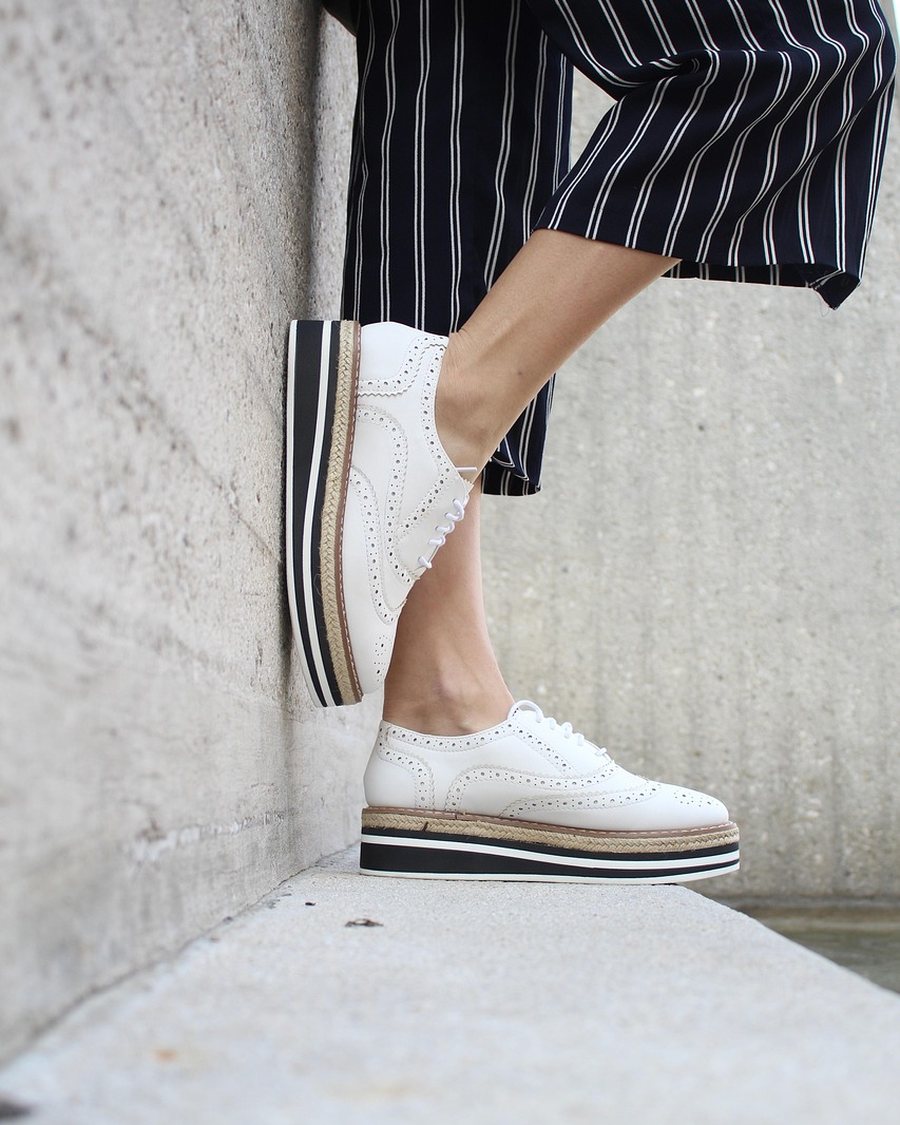
Two of these trousers cost $148 and publish front rises an eighth of an inch apart, 11 1/2 and 11 3/8. Put them over the same shoe and they behave like different garments, because one leg opening is 18 1/2 inches around and the other is 23 1/2. The third pair publishes none of those three numbers, which makes it the only one here that cannot be bought from a chart.
Two rises, one eighth of an inch apart
J.Crew publishes 11 1/2 inches on the Barrel pant in wool-blend flannel and calls it high-rise. Madewell publishes 11 3/8 inches on the High-Rise Bootcut Trouser. The eighth of an inch is below the tolerance of how a waistband is cut and sewn: two pairs of the same size can differ by that much and both be correct to spec.
What the two numbers do share is a threshold. At 11 inches and above, the waistband sits at or just over the navel on most frames, which is high enough that a tucked shirt stays in through a day of sitting. Below 10.5 inches the shirt hem clears the waistband when you reach overhead, and the belt becomes the visible waistline. The rise numbers and where each one lands are the same figures whether the trouser is flannel or denim.
The eighth of an inch also tells you what the pages are not telling you. Neither brand publishes a back rise, and back rise is the number that decides whether the seat stays up when you sit. Neither publishes a waistband depth, which changes how much of a tucked shirt the band can hold. The front rise is the one figure both brands chose to print, so it is the one the comparison can use.
The leg opening picks the shoe
18 1/2 inches is the circumference of the hem. Laid flat, that is 9 1/4 inches across. A loafer is roughly 4 inches wide at the widest point, so a 9 1/4-inch flat hem clears the shoe with room to spare and the vamp stays visible. That is what makes the Barrel pant read as a trouser rather than as a skirt: the hem ends above the shoe and the ankle does the rest.
23 1/2 inches is 11 3/4 inches flat. At that width the hem covers the top of the shoe and most of the vamp, which is what a bootcut is for. It needs a heel or a sole with some depth under it, because the hem has to be held off the floor at the back. Over a flat, the extra length puddles and the back hem drags, and the back hem is usually the first part of a trouser to fray.
Inseam compounds the choice. The Barrel is 28 inches, cut to hit below the ankle; the Bootcut is 31 inches, cut for a heel. Shortening the Bootcut by three inches does not simply raise the hem: it removes the shaped part of the flare, and what is left is closer to a straight wide leg than to a bootcut. A hem alteration changes the silhouette whenever the leg is shaped near the bottom, which is the argument in how leg opening and rise work as a ratio.
What 60, 48 and 33 percent wool do over a month
The Barrel is 60 percent wool, 35 percent polyester and 5 percent other fibers, dry clean. The Bootcut is 48 percent wool, 48 percent polyester and 4 percent elastane, machine washable, in a stretch twill. The Uniqlo pair is 33 percent wool and 67 percent polyester, in a double-layered cloth.
Wool is the fiber that resets. It absorbs moisture and releases it, holds a pressed crease, and recovers from compression with steam rather than heat. At 60 percent, the cloth behaves like wool: it will look pressed after a night on a hanger, and it will need dry cleaning rather than water. Polyester is the fiber that resists. It takes abrasion at the seat and the inner thigh better than wool, holds its shape through a wash, and can develop a shine where it is pressed flat. Elastane at 4 percent returns the cloth after it stretches, but heat degrades it, which is why a machine-washable pair with elastane should be line dried rather than tumbled.
The Uniqlo cloth is double-layered, and the page does not say which face is wool. That matters for care: a wool face takes a press and a synthetic face takes a sponge, and the two need different treatment. Without that line, the safe assumption is the gentler of the two.
None of this is a defect in any pair. It is a care burden, and care burden is a cost. A dry-clean trouser worn twice a week needs cleaning far more often than a machine-wash pair, and each clean is a separate errand. Over a year, that errand is a larger cost than the $0 gap between the two $148 prices.
Reading a page that publishes no measurements
The Uniqlo page gives a silhouette, slim carrot, a fabric, sizes 0 to 14, and an inseam alteration at the point of sale. It gives no rise, no inseam and no leg opening. A silhouette is not a measurement: two makers can both call a leg slim carrot and cut it two inches apart at the hem.
There is a way through. Measure a pair you already wear, laid flat, from the crotch seam to the top of the waistband for rise, from the crotch seam to the hem for inseam, and across the hem edge to edge then doubled for opening. Then ask the brand for the same three figures on the size you would order. A size chart that quotes a range across all sizes is not the same as the measurement on the one pair that will arrive.
The alteration offered at the point of sale covers one of the three numbers. It can shorten the leg; it cannot raise the rise or narrow the opening. If the rise is wrong, the free alteration does not save the purchase.
Seat, crease and eight hours in a chair
Back rise is the measurement none of the three pages prints, and it is the one that decides how a work trouser behaves after lunch. It runs from the crotch seam up the center back seam to the top of the waistband, and it is longer than the front rise because the body is longer behind than in front. When the back rise is short for the wearer, the waistband dips at the back the moment you sit and the crotch pulls; when it is long, the cloth pools under the seat and the trouser looks as if it has stretched.
Neither fault is a sizing error you can solve by going up or down. Sizing up adds front rise, back rise, waist and hip together, so the waistband gets looser without the seat getting better. A tailor can take a wedge out of the center back seam, but the amount is limited by the yoke and the pocket placement, and nothing can add back rise that is not there.
The cloth decides how visible the problem is. A 60 percent wool flannel recovers overnight on a hanger; the 48 percent wool twill with 4 percent elastane relaxes during the day and may not return fully until it is washed and line dried. A dark navy or black hides the shine that pressing puts into a seat; a mid-grey shows every pass of the iron. If the trouser is worn four days a week, the cloth matters more than the label.
The hem you cannot see
No page states a hem allowance, and the allowance is what decides whether the trouser can ever be let down. A hem with an inch of cloth turned under can be let down once, by most of that inch, before the old crease shows. A hem with a quarter inch cannot be let down at all. On a $148 pair the difference is invisible online and decisive in a tailor’s hands.
Shortening is the easy direction. Any of the three can lose length, and the Uniqlo pair is shortened at the point of sale. Lengthening is the one that depends on a figure nobody publishes, which is why it is worth asking before ordering rather than after. Whether an alteration is worth paying for usually comes down to how much cloth is folded inside the hem, not to the skill of the tailor.
There is a second hidden allowance: the waist. A waistband can usually be taken in an inch or so without moving the pockets, but letting one out depends on the seam allowance left inside. On a finished trouser that is rarely more than a quarter inch.
When a wool blend is the wrong cloth
If everything in the wardrobe goes in the machine, only the Bootcut qualifies here, and even that one should be line dried to protect the elastane. A dry-clean trouser that gets washed once by mistake will not be ruined, but the crease will blunt and the hem can shrink enough to show the old line.
If the trousers are worn hard, five days a week on abrasive office chairs, a higher wool share is not automatically the better buy. Wool wears at the seat and the inner thigh, and a 48 or 33 percent blend is the safer bet to outlast a 60 percent flannel in the same rotation. The flannel is the better cloth for the meeting, not for the commute.
If the outfit needs a sharp crease that survives a full day, a wool-rich cloth pressed at home will hold better than a polyester-rich one, which tends to develop a rounded fold rather than an edge. And if the trousers have to work with a flat shoe, the 23 1/2-inch opening is the wrong starting point regardless of cloth: the hem will cover the shoe and read casual no matter how the rest is styled.
Which pair
If you tuck your shirt and want the waistband to stay where you put it, the Barrel pant in wool-blend flannel is the highest wool content here at 60 percent, the narrowest hem at 18 1/2 inches, and the shortest leg at 28 inches, which suits a flat. It is also the only one that must be dry cleaned.
If you wear a heel and want the hem to cover the shoe, the High-Rise Bootcut Trouser gives you 23 1/2 inches of opening, a 31-inch inseam and a machine-washable cloth. It is the more practical daily pair and the less formal one, and hemming it changes what the leg is.
If you want a lighter wool share and can use the inseam alteration, the U Wool-Blend Pleated Pants is the third option at 33 percent, provided you can find a rise figure before you order. Without one, the free alteration fixes the only number you could have measured at home anyway.
The shortlist
What we would pick
Some links below are affiliate links — we may earn a commission at no extra cost to you.
Two of the three trousers share a price and a rise within an eighth of an inch, then split on the hem: 18 1/2 inches against 23 1/2. The third publishes no rise, no inseam and no leg opening, which makes it the hardest of the three to buy without trying on. Wool content runs from 60 percent down to 33 percent, care follows it, and not one of the three publishes a back rise, which is the figure that decides the seat.
- Shortlist
- 3 wool-blend trousers, $148 where priced
- Rise
- 11 3/8 to 11 1/2 in where published
- Leg opening
- 18 1/2 in and 23 1/2 in where published
- Wool content
- 33% to 60%
- Back rise
- Not published by any of the three
Barrel pant in wool-blend flannel
USD 148J.Crew
The highest wool content here at 60 percent, with 35 percent polyester and 5 percent other fibres, and dry clean only. It is cut as a barrel: wide through the thigh, slightly curved at the hem, with an 18 1/2-inch opening and a 28-inch inseam designed to hit below the ankle. Five-pocket styling and a zip fly make it the least formal of the three, and the narrow hem is what keeps a flat shoe visible under it. The 11 1/2-inch rise is the number that keeps a tucked shirt in place, though the page publishes no back rise, so the seat has to be judged in a fitting room. It is the wrong pair for anyone who wants to machine wash, and the wrong pair over a heel, because 28 inches will not cover the shoe.
- Fabric
- 60% wool, 35% polyester, 5% other fibres
- Front rise
- 11 1/2 in
- Inseam
- 28 in
- Leg opening
- 18 1/2 in
- Care
- Dry clean
High-Rise Bootcut Trouser
USD 148Madewell
An 11 3/8-inch rise, a 31-inch inseam and a 23 1/2-inch leg opening, in a stretch twill of 48 percent wool, 48 percent polyester and 4 percent elastane. It is the only one of the three that is machine washable, which follows from the polyester share rather than from any finish, and the elastane is the reason it should be line dried rather than tumbled. Patch pockets at the front and a fitted hip make it read more casual than the numbers suggest. The wide hem needs a heel or a substantial sole under it, and shortening the leg by three inches removes the shaped part of the flare, turning it into a straight wide leg. It is the best daily pair here and the least useful one with a flat.
- Fabric
- 48% wool, 48% polyester, 4% elastane
- Front rise
- 11 3/8 in
- Inseam
- 31 in
- Leg opening
- 23 1/2 in
- Care
- Machine wash
U Wool-Blend Pleated Pants
Uniqlo
33 percent wool and 67 percent polyester in a double-layered cloth, cut as a slim carrot shape borrowed from menswear. Inseam alteration is offered at the point of sale, which matters because the page publishes no inseam, rise or leg opening to compare against the other two, and the alteration fixes only the length. Sizes run 0 to 14. The page also does not say which face of the double-layered cloth is wool, so the safe assumption for care is the gentler of the two. It is the only one of the three whose fit has to be judged in a fitting room rather than from a measurement, and the only one with a polyester majority.
- Fabric
- 67% polyester, 33% wool, double-layered
- Silhouette
- Slim carrot
- Alteration
- Inseam alteration available
- Rise
- Not listed
- Leg opening
- Not listed
- Care
- Not listed
| Specification | Barrel pant | High-Rise Bootcut | U Pleated Pant |
|---|---|---|---|
| Wool content | 60% | 48% | 33% |
| Front rise | 11 1/2 in | 11 3/8 in | Not listed |
| Inseam | 28 in | 31 in | Not listed |
| Leg opening | 18 1/2 in | 23 1/2 in | Not listed |
| Silhouette | Barrel | Bootcut | Slim carrot |
| Care | Dry clean | Machine wash | Not listed |
| Price | USD 148 | USD 148 | Not published |
Where these numbers come from
Frequently asked
- Does an 11 1/2-inch rise sit above the waist?
- It sits at or just above the navel on most frames, which is high enough to keep a tucked shirt in place. Anything under 10 inches sits below the hip bone and starts to slide when you sit.
- Is a 23-inch leg opening too wide for the office?
- Not on its own. A 23-inch opening is a bootcut or a strong flare and needs a shoe with some volume under it. Over a flat, the hem covers the shoe and reads more casual than the same cloth at 18 inches.
- Can a wool-blend trouser be machine washed?
- Only if the care label says so. One pair here is machine washable because it is 48 percent polyester; the other two do not state care on the page. Washing a dry-clean trouser will blunt the crease and shrink the hem.